Say It Plain: The Quiet Rebellion Against the Artist Statement
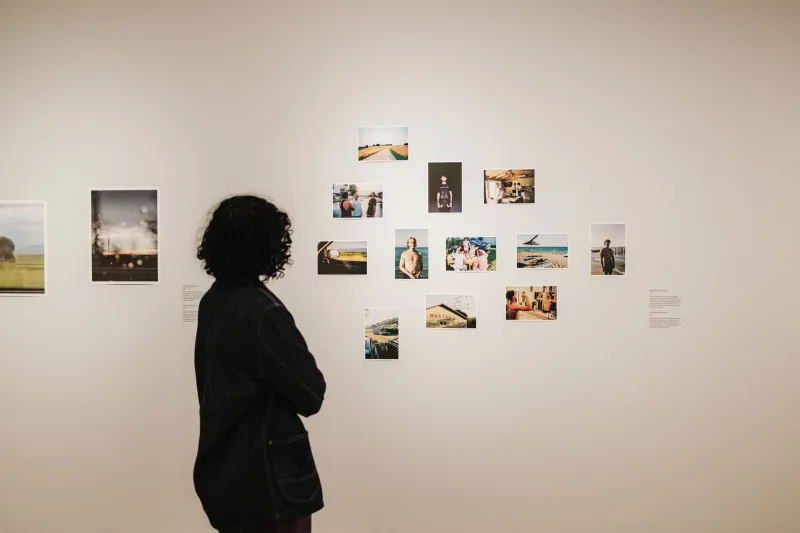
In a former hardware store on the north side of Duluth, Minnesota, a wall label does something unusual: it apologizes. “I started this painting the week my father died,” it reads. “It took three years. I am still not sure it is finished.” The painter is a retired schoolteacher named—we’ll call her M.—and the label is taped to the wall with masking tape. There is no mention of “liminality,” no invocation of “materiality,” no “interrogation of the gaze.” There is only a person, a loss, and a canvas. Visitors linger there longer than they do at the professionally printed placards in the next room.
This is the case against the artist statement—not against artists thinking, but against a convention that has hardened into a gate. The impenetrable paragraph, the one that begins “My practice explores,” has become so routine that we rarely ask what it is for. In small museums and co-op galleries across the country, a quiet counter-movement is underway: plain-language wall texts, artist-led walkthroughs, and labels that sound less like a dissertation abstract and more like a neighbor leaning over the fence.
The Label as Gatekeeper
The artist statement arrived with good intentions. As conceptual art and institutional critique matured in the 1970s and 1980s, the explanatory text became a way to situate work that resisted easy reading. But what began as an aid became a credential. Today, MFA programs drill the statement into students; grant applications demand it; commercial galleries use it to signal seriousness to collectors. The result is a genre with its own clichés— “tension,” “interrogate,” “liminal,” “the body as site” —that often tells the viewer less than a single sentence of plain speech.
The cost is not merely aesthetic. It is democratic. At a co-op gallery in Asheville, North Carolina, I watched a visitor read a label three times, frown, and walk away from a painting she had been visibly moved by. The label had used the word “hegemonic” twice. She later told a volunteer she “didn’t know enough” to look at the work. She knew enough. The label told her she didn’t.
What Plain Text Costs
Plain language is not anti-intellectual. It is a choice about where difficulty lives. The difficulty should be in the work, not in the wall text. When the label says, “This is a portrait of my grandmother, who could not read, and the text in the background is the letter she dictated to me,” the viewer is invited in. The painting’s complexity—its handling of paint, its play with legibility—remains. Nothing is dumbed down. Something is opened.
At the community art center outside Asheville, director Elena Ruiz has spent two years replacing borrowed curatorial language with what she calls “first-draft labels.” Artists write a paragraph, then rewrite it as if explaining the work to a friend at a bar. “The first draft is usually the statement,” Ruiz says. “The second draft is the truth.” The center now includes both: the formal statement in a binder, the plain label on the wall. Attendance at walkthroughs has doubled. Sales, modest before, have not fallen.
The Walkthrough as Antidote
The artist-led walkthrough is the other half of the experiment. At the county historical museum in Beloit, Wisconsin, a printmaker named—we’ll call him J.—leads a Saturday tour in which he refuses to use the word “practice.” Instead he says, “I make things because I am bad at talking.” He shows a series of linocuts about his brother’s deportation hearing. The crowd is silent, then asks questions that have nothing to do with technique. The museum’s curator admits she was nervous: “We thought people wanted expertise. They wanted a person.”
This is not an argument against expertise. It is an argument against expertise as a barrier. The wall label can be a door or a wall. The plain-language experiments suggest that most visitors prefer a door.
The Risk of Saying Too Little
There is a real risk in all this. Some work genuinely needs context: a series about redlining, a piece quoting a treaty, a sculpture referencing a local lynching. Plain speech does not mean no speech. The best plain labels are specific, not vague. They name what is in the frame and why it is there. They trust the viewer with facts, not just feelings.
At the Belden Gallery in Portland, Maine, a label for a series of photographs of the working waterfront reads: “These are the last three sardine packers in the city. They are 78, 81, and 84. The plant closes in June.” That is not an artist statement. It is a sentence that does work.
A Neighbor’s Grammar
The case against the artist statement is not a case against artists. It is a case against a habit that has made art feel like a private club. In Duluth, M.’s masking-tape label has been reprinted on card stock and hung in the lobby. Visitors photograph it. One wrote beneath it: “Thank you for saying it plain.” The painting is still not finished. The label is.
That is the radical possibility: that art can speak like a neighbor, and that a neighbor can speak back.