Steel, Paint, and the Postman's Dilemma: The Folk Artists Turning Curbsides Into Galleries
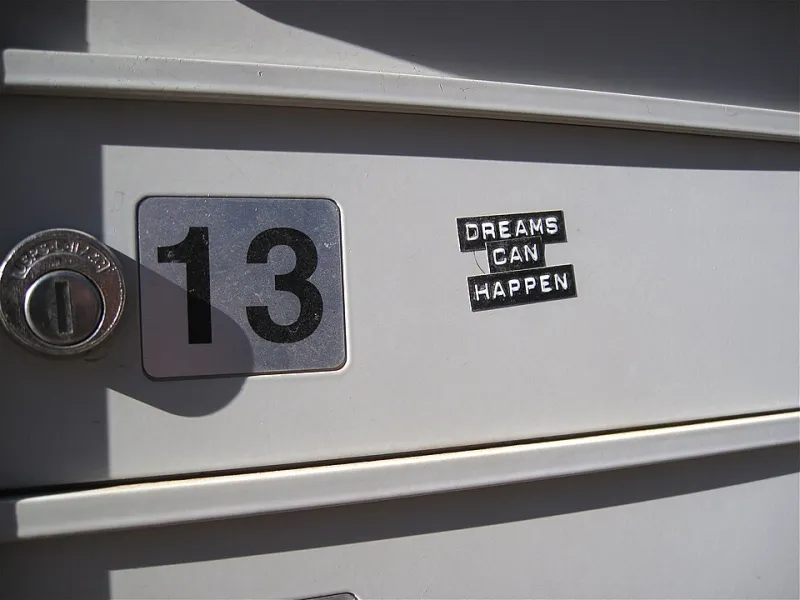
Photo: cogdogblog, CC0, via Wikimedia Commons
A Lighthouse in a Landlocked State
Drive U.S. Route 36 through northern Kansas and, somewhere past the grain elevators, you may spot it: a full-scale lighthouse, red and white striped, standing sentinel over a soybean field. It marks no water. It guides no ships. It announces, quite simply, that someone lives here — and that someone wants you to know it.
The lighthouse is a mailbox. And it is not alone.
From the painted barns of Vermont to the welded sunflowers of the Texas Panhandle, rural America's curbsides host a sprawling, unofficial museum. Its curators are retired welders, farm wives with steady brush hands, teenagers with a MIG welder and something to prove. Its visitors are mail carriers, school bus drivers, and the slow parade of strangers who honk in approval or stop to take a photograph. No admission fee. No gift shop. Just the daily ritual of retrieval.
The Shape of Recognition
For most of the twentieth century, the rural mailbox was a quiet civic contract: a standard box on a standard post, telling the postal service where to stop and the neighbors who you were. But standardization has always had its rebels. In 1963, when the Postal Service imposed a uniform size standard, folk artists adapted — working within dimensions, if not within decorum.
What emerged was a distinctly American vernacular form. The mailbox as self-portrait. The retired Coast Guardsman whose box is a buoy. The dairy farmer whose aluminum Holstein moos — via a salvaged truck horn — when the door swings open. The widow in eastern Colorado who repaints her late husband's fly-fishing box every spring, the same river scene, slightly different each year, like memory itself.
"People think it's whimsy," says Dale Ferris, who welds mailbox sculptures in a shop outside Wahoo, Nebraska. "Sometimes it is. But mostly it's a statement. Out here, your driveway is a quarter mile long. That box is the handshake before the handshake."
The Paperwork Problem
The quiet war Ferris references is real, if rarely loud. Postal regulations technically govern mailbox construction — height, reach, structural standards — but say little about aesthetics. The sharper threat comes from closer to home: homeowners associations and county ordinances that treat the decorative mailbox as a nuisance, a blight, a thing to be cited.
The result is a legal gray zone that folk artists navigate with the same improvisation they bring to their materials. Some have consulted lawyers over six-foot-tall mailbox cathedrals. Others have learned the local code enforcement officer's patrol schedule by heart. A few, defiantly, have simply rebuilt.
It's tempting to read this as small-stakes absurdity. It is anything but. The mailbox sits on the exact boundary between private expression and public space — a patch of curb where the individual and the collective negotiate, daily, what a streetscape should look like. When an HOA mandates uniform boxes, it makes an argument about conformity. When a farmer answers with a thirty-pound welded eagle, he makes a counterargument in steel.
What the Box Says
Sociologists have long noted that Americans decorate their mailboxes at higher rates than almost any other nation — a fact historians trace to the Rural Free Delivery Act of 1896, which first brought the mail directly to the farm gate. The mailbox arrived as a symbol of connection to the wider world, and Americans have been personalizing that connection ever since.
To read a rural mailbox honestly, then, is to read a message intended for you. The hand-painted pineapples say welcome. The miniature fire truck says this household serves. The faded, carefully repainted flag says something about endurance that no slogan could. In an era when so much of our communication is curated, encrypted, and deleted, the mailbox is a rare piece of expression that stands in the weather, unguarded, for anyone passing by.
There is a politics to this, whether the artists claim it or not. The push toward the uniform — the same box, the same post, the same muted colors approved by committee — is the same logic that flattens main streets into strip malls. The mailbox artists, most of whom would never call themselves artists at all, are practicing a small, stubborn resistance. They are insisting that the road into town need not look like the road out of everywhere else.
The Next Generation of the Ordinary
There are signs the tradition is not merely surviving but evolving. County fairs across the Midwest now host decorated mailbox competitions. A cooperative gallery in Iowa City sells mailbox sculpture alongside studio pottery. And on social media, hashtags documenting curbside folk art have introduced a new audience to a form they'd driven past their whole lives without seeing.
Whether the lighthouses and roosters and moose will outlast the regulations, the subdivisions, and the slow suburbanization of the rural fringe is an open question. But Dale Ferris, for one, is not worried. He gestures at a half-finished piece on his workbench — a mailbox shaped like a barn, weather vane included.
"Somebody ordered this," he says. "Somebody out there wants their corner of the road to look like them. That want doesn't go away. It just finds a new post to stand on."
Somewhere down a gravel road, the mail is coming. And it is arriving, as it has for a century, at a small work of art.