Final Drafts: The Volunteer Obituary Writers Keeping Small-Town Memory Alive
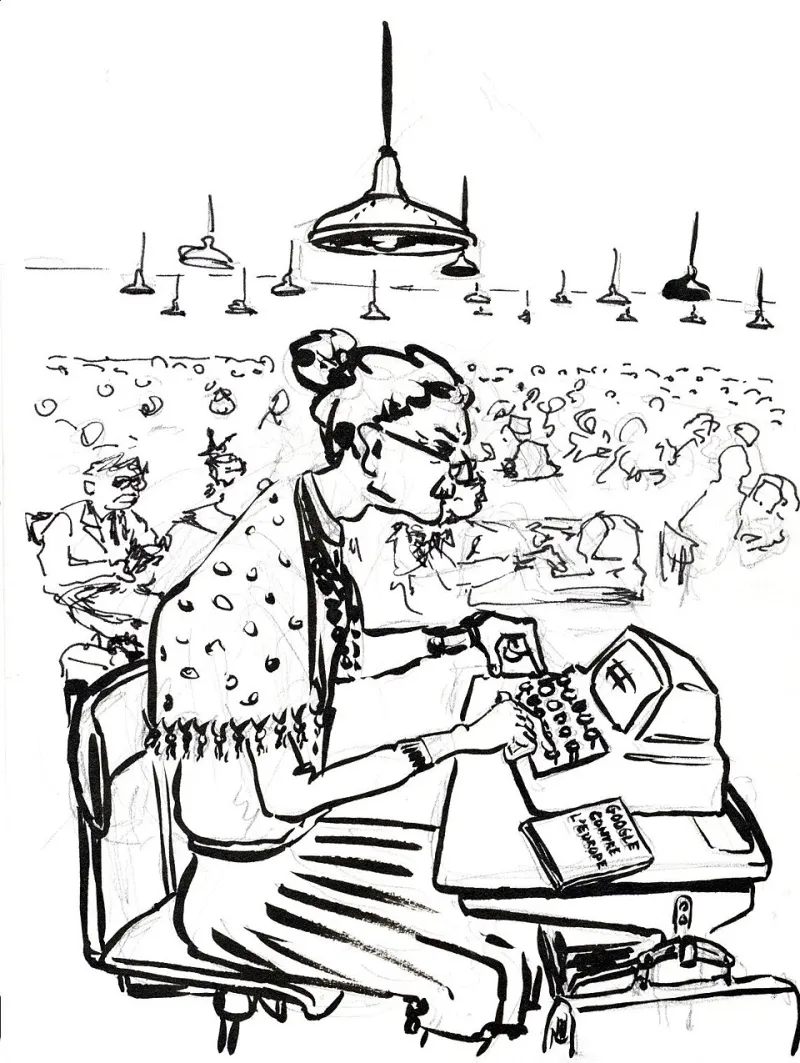
Photo: Rama, CC BY-SA 2.0 fr, via Wikimedia Commons
The Typewriter in the Back Room
On a Tuesday morning in Wabash County, Indiana, a woman named Ruthie Kessler sits down at a manual typewriter older than most of her readership. She has a stack of funeral home printouts, a phone message from a neighbor about a man who died Saturday, and roughly four hours before she needs to have the month's memorial newsletter at the copy shop. She is not paid. She has not been paid in nineteen years. She will tell you, if you ask, that she doesn't want to be.
Kessler is one of hundreds of volunteer obituary editors working across the American heartland — in towns where the county paper closed, the church bulletin thinned out, and the only remaining record of a life lived is whatever a neighbor can be persuaded to write down. Their work is part journalism, part eulogy, part folk art. And as local news deserts spread across the country, these humble memorial pages have quietly become something larger: the last drafts of a town's collective memory.
What the Paper Never Covered
The standard newspaper obituary is a genre of constraint — a few column inches, a formula of surviving relatives, a funeral time. The volunteer editors work in a different register entirely. Freed from editorial oversight and advertising pressure, they write what the community actually knows: that Harold coached Little League for twenty-two years and never once kept score; that Dottie's rhubarb pie took a blue ribbon at the county fair in 1987 and she never let anyone forget it.
"The paper always got the dates right and the person wrong," Kessler says. "I'd rather get the person right."
This is, in a sense, an old American tradition returning to its roots. Before the obituary became an institutional product, it was a communal one — passed by word of mouth, read from the pulpit, stitched into quilt squares and family Bibles. The volunteer editors are not reviving that tradition so much as refusing to let it die. Their newsletters circulate by mail, by church narthex, by the corkboard at the co-op. Some run to forty pages. Some are photocopied on the sly at the feed store. All of them treat the ordinary life as though it were worth recording in full, because in these towns, it is.
The Ethics of the Final Word
The work is not without its complications. Writing about the dead means writing about the living, and volunteer editors navigate a thicket of family feuds, estranged children, and causes of death nobody will say aloud. There is no style guide. There is no lawyer. There is only the editor's sense of what the town can bear to know and what the deceased would have wanted told.
Several editors describe a personal code. One, in eastern Oregon, refuses to omit a person's struggles with addiction or incarceration — "a life is a whole thing," she insists — while softening details that would wound the still-living. Another keeps a private notebook of the true stories that couldn't fit in print, on the theory that someone, someday, will want the whole record. Between the public page and the private notebook, these editors are doing the archival work that institutions abandoned, one mimeographed sheet at a time.
An Archive Written by Its Subjects
What makes these pages remarkable as documents is their intimacy of detail. Historians of the future will find in them what no census or database can provide: how a town understood itself, what it valued, who it forgave and who it didn't. A life summarized as "she made everyone feel like the most important person in the room" tells you something about the town that wrote it — about what it aspired to, and mourned.
There is a progressive argument hiding inside this seemingly nostalgic practice. In an era when memory is increasingly held by platforms that monetize attention and forget nothing but context, the community-run obituary page is a small act of reclamation. It insists that memory is a civic function, best performed by neighbors rather than algorithms. It insists that every life, however unremarkable on paper, deserves a careful reader and a careful writer.
The Succession Problem
The editors are aging, and most have no successor. Ruthie Kessler is seventy-eight. She has tried to recruit younger volunteers; the young people, she says, are willing but scattered, and many have moved to cities where nobody asks them to write anything down. Some newsletters have migrated online, to community Facebook groups and free website builders, gaining reach but losing the material permanence of paper.
Yet the impulse persists. In college towns and commuter suburbs, a new generation is experimenting with the form — memorial zines, oral history projects, neighborhood memorial pages with editorial standards and fact-checking. The medium changes; the calling does not. Someone, in every community, eventually steps forward to do the unglamorous, unpaid, essential work of remembering.
Kessler puts it plainly. "Nobody else was going to write it," she says of the first obituary she took on, in 2006. "And it seemed like somebody should." That sentence — somebody should — is as good a mission statement as American journalism has produced in decades. It is not a business model. It is a covenant, renewed one final draft at a time.