Folded, Stapled, and Alive: The Amateur Editors Bringing Back the Photocopied Bulletin
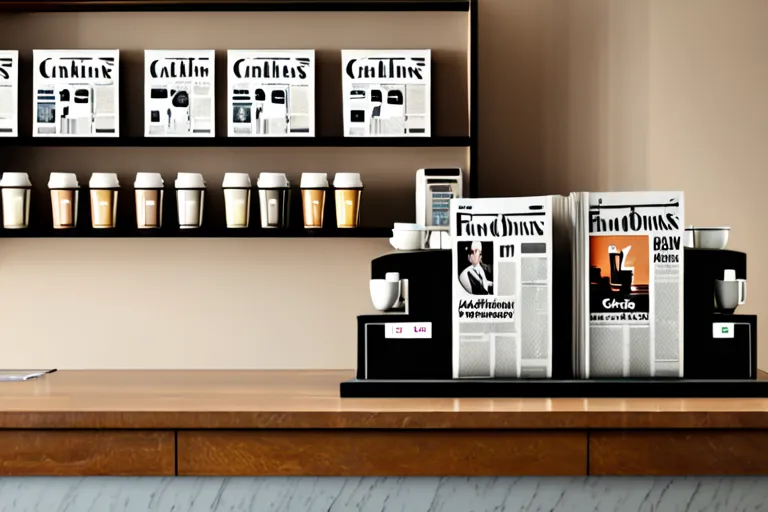
Photo: photocopied zine newsletter on coffee shop counter stack, via data.ipic.ai
There is a particular sound a photocopied bulletin makes when you unfold it — a small, papery protest, like the document would rather stay folded. It is not a sound anyone associates with urgency. And yet, in coffee shops, hardware stores, and library vestibules from Vermont to Oregon, that sound is becoming surprisingly common again.
The people responsible are not nostalgists, at least not primarily. They are amateur editors — a retired mail carrier in Duluth, a barista in Asheville, a high school English teacher outside Wichita — who have concluded that the neighborhood Facebook group, for all its convenience, cannot do the one thing a folded sheet of paper can: make a community slow down long enough to belong to itself.
The Economics of Eight Pages
Consider the arithmetic. A typical issue of these bulletins costs between twelve and thirty dollars to produce, mostly in toner and copy-shop fees. Distribution is a network of acrylic holders and honor-system stacks. There is no analytics dashboard, no engagement metric, no way to know whether anyone read past the lost-dog notice on page one.
That blindness, the editors insist, is the point.
"When you post something online, you're competing with everything," says the pseudonymous publisher of a monthly zine in Asheville that covers two neighborhoods and roughly four thousand residents. "When somebody picks up the paper copy, they've already made a decision. They've chosen to give it their attention. I don't have to trick them into it."
The format imposes its own discipline, too. Eight pages forces editorial judgment. There is no room for the infinite scroll of the civic feed — the arguments, the reposts, the ambient grievance. What survives the cut tends to be the durable stuff: the closure of a laundromat, the retirement of a crossing guard, the third-generation bakery that almost didn't make it through the winter.
Three Publications, Three Theories of Place
The revival is not a movement in any organized sense, but the publications profiled for this piece share an unexpected kinship.
In Duluth, a retired mail carrier produces a bulletin whose entire editorial philosophy can be summed up in his refusal to print anything negative. Critics call it sanitized; he calls it "a porch, not a courtroom." His circulation — around six hundred copies, left at the food co-op and the bait shop — has doubled in two years.
Outside Wichita, a teacher's zine takes the opposite approach, running pointed coverage of school-board decisions the local paper no longer has staff to attend. It is photocopied on the sly after hours and reads like the last remaining witness in the room.
And in Asheville, the barista's zine is less a news product than a serialized portrait — interviews with the woman who has run the laundromat's change machine for thirty years, the teenager who repaints the faded crosswalk stencils, the man who feeds the crows and has opinions about them.
Three formats, one shared conviction: that a place is made of stories small enough to be overlooked by everything larger than a sheet of paper.
Why Paper, Why Now
Sociologists have long noted that shared physical objects function differently than shared digital ones. A bulletin left on a counter is ambient; it waits without demanding. It can be read by four people before it is recycled, and each of them encounters it without having been targeted, optimized, or served. In an era when civic information arrives pre-sorted by engagement algorithms, the untargeted document reads almost as a provocation.
There is also a generational current running beneath the revival. Many of the newest editors are under thirty — people who came of age online and have developed, in the phrase one of them used, "a tolerance problem" for feeds. For them, the photocopier is not retro; it is a tool that does exactly one thing, at a cost they can see, with no one watching.
The Fragile Future of the Fold
None of the editors interviewed for this piece believes they are saving journalism. The bulletins are too small, too irregular, too dependent on the goodwill of hardware store owners who agree to stock a stack of papers nobody pays for. Several admitted they might stop next year, the way these projects tend to end — not with a shutdown announcement, but with a missed month that becomes two.
But fragility may be the medium's quiet strength. A publication that could vanish at any moment asks something of its readers that a permanent platform never does: notice it while it's here. Fold it back along its crease. Pass it along.
The algorithm promises everything and delivers everything, which is another way of saying it delivers nothing in particular. The bulletin promises eight pages and a staple. Increasingly, that is the offer more people are willing to walk across a room for.