The Body in the Banquet Room: Who Killed the Dinner Party, and Why Gen Z Is Investigating
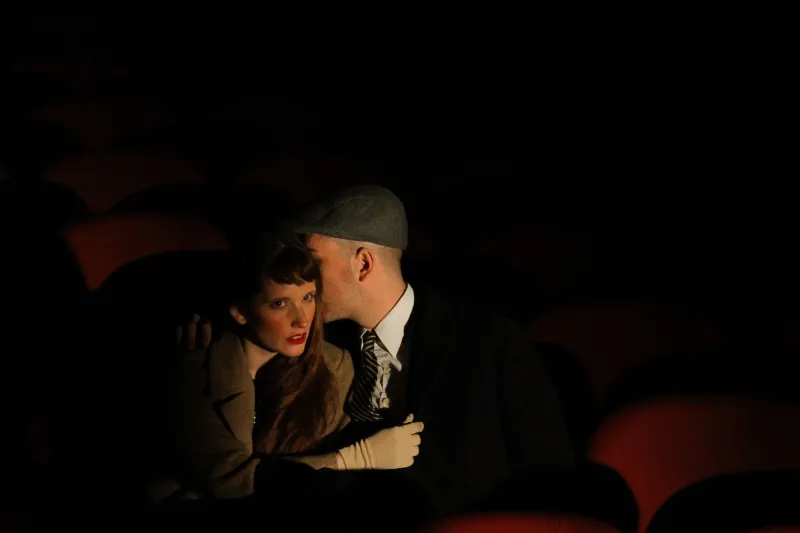
On a Saturday evening in Dayton, Ohio, forty strangers file into a hotel banquet room decorated to resemble a 1947 radio station. They are handed character cards, cheap props, and a collective assignment: figure out who poisoned the program director before dessert. Among them are retirees in vintage brooches, a bachelorette party in matching sashes, and a table of five college students who drove ninety minutes for this — one of whom has attended eleven times.
A decade ago, the murder mystery dinner theater occupied a specific place in the American imagination: a punchline, a corporate retreat activity, something your aunt booked for a milestone birthday. It was entertainment as punch and pie. Today, it is quietly becoming one of the more resilient live-performance formats in the country, and the demographics of its revival are the surprising part. The people filling banquet rooms in Dayton, Chattanooga, and Des Moines are increasingly in their twenties — the generation presumed to have been fully absorbed by their phones.
Participation as the Product
The economics of these ventures are modest by design. Most operations run on a cast of six to ten semi-professional actors who plant clues among the tables, then rely on the audience to do the dramatic heavy lifting. There is no fourth wall to speak of. The product being sold is not a performance in any conventional sense; it is permission to participate.
That permission turns out to be scarce. Cultural critics have spent a decade diagnosing the decline of so-called third places — the bars, lodges, and community halls where Americans once mingled with strangers. The mystery supper club, whether its owners intend it or not, functions as a third place with a script. Strangers are required to talk to one another. There is a shared task, a time limit, and a socially sanctioned reason to argue with the person seated next to you about whether the dentist did it.
Compare that to the dominant mode of contemporary leisure. Streaming offers infinite content and zero obligation. The mystery dinner offers finite content and total obligation — you are, however briefly, a character rather than a viewer. For audiences who grew up fluent in interactive media, the leap from video game to banquet-room sleuthing is smaller than their parents might assume. The format simply delivers in physical space what games have always promised: agency, stakes, and consequences, followed by prime rib.
The Amateur Advantage
What keeps people returning, owners say, is not the plotting, which tends toward the serviceable. It is the amateurishness itself. When a guest in a rented detective coat accuses the hotel's actual banquet captain of murder, the evening acquires an authenticity no prestige drama can manufacture. The genre thrives on its own imperfection.
This tracks with a broader shift in how younger audiences relate to culture. The most vital corners of contemporary entertainment — from tabletop role-playing's mainstream breakthrough to the explosion of live improv — share a common architecture: a loose framework, a willing room, and the understanding that the audience completes the work. The mystery supper club is, in this light, not a revival at all. It is an early prototype of participatory entertainment that simply outlasted its own reputation.
There is also a quieter argument buried in the banana split. These evenings are stubbornly local. They employ local actors, fill local hotel ballrooms, and give midsize towns a cultural export that cannot be downloaded. In an entertainment economy that concentrates value in a handful of coastal streaming libraries, a form that requires seventy-five people to be in one physical room in Ohio begins to look less like kitsch and more like infrastructure.
Whodunit, Indeed
None of this is to say the format is above critique. The scripts can lean on creaky stereotypes; the immersive-theater boom has raised audience expectations that banquet-room budgets cannot always meet. Operators who survive will be the ones who treat the genre as theater rather than novelty — who hire directors, rewrite scripts annually, and resist the temptation to coast on the gimmick.
But the deeper lesson of the revival belongs to the culture, not the industry. Americans did not stop wanting to gather, perform, and puzzle together; they simply lost the venues. The murder mystery supper club endures because it never stopped offering them. The body in the banquet room, it turns out, was never the mystery. The mystery is why we ever assumed strangers would rather stay home.