Spiral-Bound Nation: The Humble Church Cookbook as America's Truest Archive
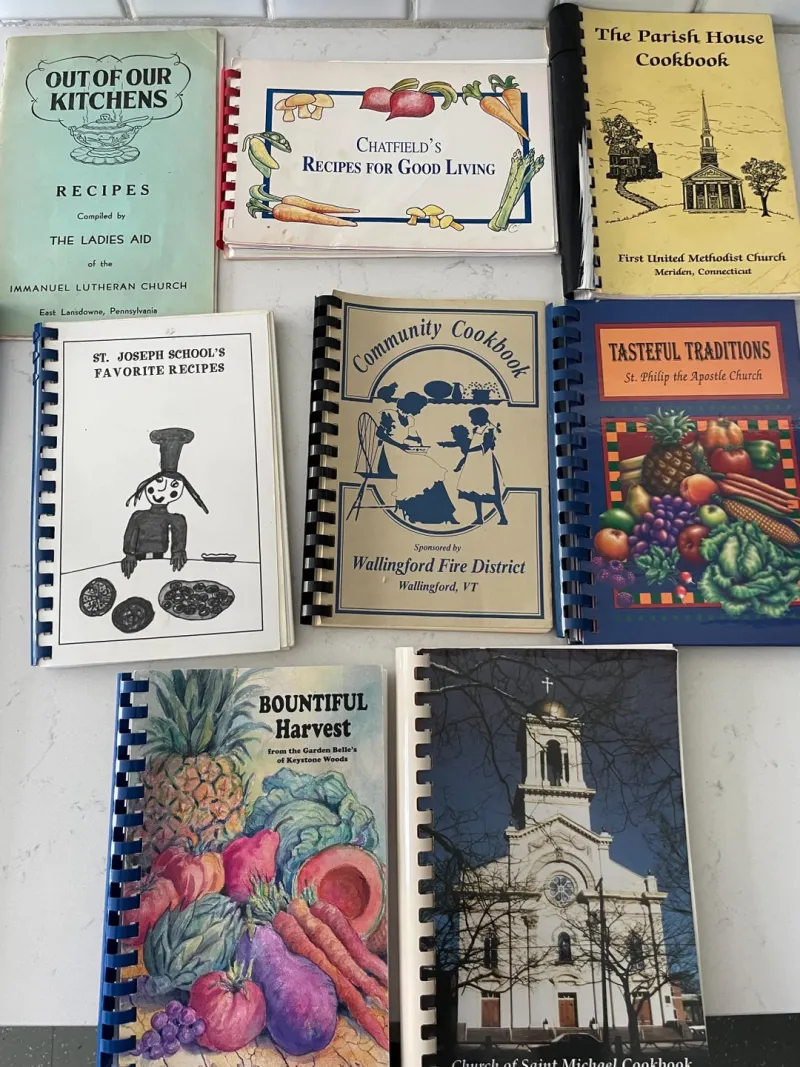
Photo: vintage spiral bound community cookbook worn pages retro kitchen, via i.etsystatic.com
Somewhere in a thrift store outside Dayton, Ohio, a woman named Betty is about to be forgotten. Her green bean casserole variation sits on page 47 of a 1978 Methodist church cookbook, attributed in that confident cursive of a certain generation: "Betty's Special — from the kitchen of Betty Holcomb." Nobody buying the book will know who Betty was. And yet, in a sense, Betty told us everything. She told us where her people came from, what their church raised money for, which convenience foods had entered the sacred orbit of the potluck, and how a community fed itself when it needed to feed itself.
Community cookbooks — the church compilations, the Junior League volumes, the volunteer fire department stapled-and-sold specials — may be the most democratic folk art this country has ever produced. They are also, increasingly, recognized as something more: a parallel national archive, one written not by the powerful but by the fed.
The Genre Nobody Meant to Invent
No one set out to create great literature. That is precisely the point. The first recognizable American community cookbook appeared in 1864, when Confederate widows in Texas compiled recipes to fund medical supplies — a document of scarcity and solidarity in equal measure. By the twentieth century, the form had metastasized into every corner of the republic: synagogues in Cleveland, granges in Vermont, Black women's clubs in Atlanta whose 1930s volumes doubled as acts of intellectual self-fashioning that scholars are still unpacking.
The format imposed a kind of accidental honesty. Celebrity cookbooks are performances; community cookbooks are minutes from a meeting. A recipe for "Dorito casserole" sits beside a handwritten attempt at a Sicilian grandmother's biscotti, and the juxtaposition is not a flaw — it is the census. These volumes record the moment a family's old-country cooking met the supermarket shelf, the moment Velveeta entered the canon, the moment a region's identity was negotiated one submitted recipe at a time.
What the Casserole Knows
Food historians have long mined these books for exactly this reason. An Iowa farm bureau cookbook from 1954 tells you about commodity agriculture and the gendered economics of the rural kitchen. A Vietnamese-American parish cookbook from Houston tells you about resettlement, adaptation, and the quiet work of making a new place taste like somewhere else. The recipes for lutefisk in Minnesota Lutheran volumes are not merely recipes; they are a stubbornness, preserved in gelatin.
What no institutional archive captures quite the same way is the annotation of ordinary life. Community cookbooks are full of dedications, memorials, and small confessions — "my husband's favorite," "for the bazaar, always sells out." Read enough of them and the abstraction of "American foodways" resolves into particular people, particular kitchens, particular Tuesdays.
The Rescue Mission
Now a new generation is treating these books as heritage worth saving. Young collectors troll estate sales and library discards, trading finds on social media under tags that treat a 1962 Extension Service cookbook like a rare pressing. Design students are scanning and reissuing forgotten volumes. University special collections — including notable holdings at the University of Iowa and the Schlesinger Library — have spent years building community cookbook archives, and digital projects are making them searchable in ways their spiral bindings never allowed.
There is urgency to it. These books were made cheaply, kept carelessly, and discarded without ceremony. Their paper yellows; their bindings split; their custodians pass away. Unlike a first edition, nobody thought to preserve them, which means the survival of each one is a small accident of sentiment rather than design.
Against the Glossy Version
The rescue effort carries a quiet argument with the contemporary food world. Today's food media is a literature of expertise — of technique videos, of authority, of the chef as auteur. Community cookbooks belong to a different tradition entirely: one in which the only credential required was a kitchen and a community willing to claim you.
That tradition has its blind spots, of course. These volumes can reflect the exclusions of their makers, and their cheerful uniformity sometimes conceals who was never invited to submit a recipe. Reading them critically is part of honoring them honestly.
But their central achievement endures. They proposed that a person's ordinary dinner was worth writing down, worth selling for a fundraiser, worth keeping. In an age when culture is increasingly produced by professionals for consumption, there is something almost radical in volumes made by amateurs for each other — unedited, unpolished, and utterly uninterested in being impressive.
Betty would not have called it art. She called it her special. We are only now learning to read it as both.