Orchestras of the Ordinary: When a Hometown Hires Someone to Write Its Soundtrack
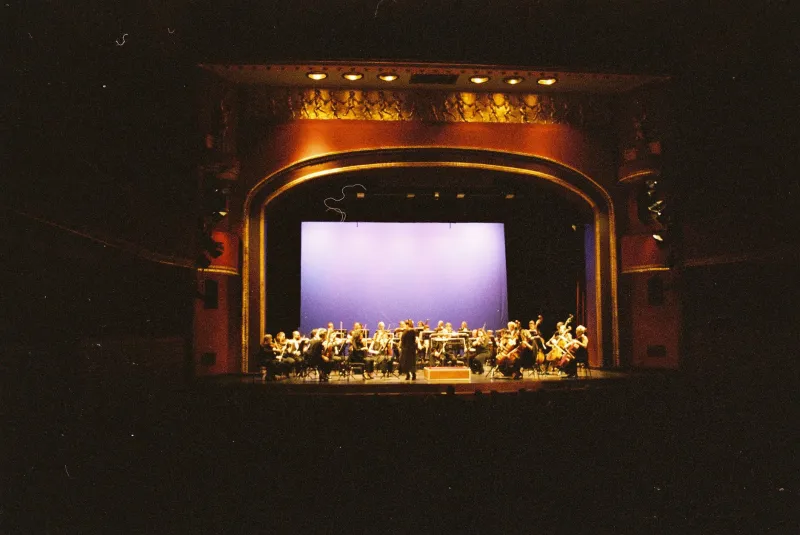
The premiere began, as many do, with the tuning of strings. But in the fourth row of the restored opera house in Claremont, New Hampshire, an elderly woman in a mill-workers' union pin was already crying — two measures in, before a single melody had a chance to form. The oboes were playing back the sound of the looms.
She would have recognized it anywhere. So would the two hundred other people in the hall, most of whom had spent some portion of their lives inside the paper mill that once defined the town's waking hours. Composer Maria Santos had spent eight months recording the building's machinery before it was decommissioned, interviewing retired workers, transcribing the cadence of their speech. What the orchestra performed that night was not a portrait of Claremont. It was Claremont, arranged for forty musicians and an audience of the depicted.
Across the country, this is becoming a genre unto itself. Civic orchestral commissions — once the exclusive indulgence of metropolitan institutions — have migrated to towns of eight, ten, twenty thousand people. The reasons are part economics, part elegy.
The Commission Economy Comes to Main Street
The mechanics are surprisingly grassroots. A library grant here, a community foundation gift there, a crowdfunding push buoyed by the local Rotary club. What distinguishes these projects from traditional municipal arts spending is their source material: not the composer's imagination, but the town's own archive. Oral histories collected at the senior center. Field recordings of the gravel pit, the high school marching band, the freight line that still runs at 3 a.m.
In Ottumwa, Iowa, the commission drew on decades of taped interviews with Hungarian and Vietnamese immigrants, weaving their arrival stories into a single continuous work. In Lewiston, Maine, the composer embedded with Somali Bantu community leaders for months — a collaboration that, whatever its artistic merits, put two populations who rarely shared a room into the same rehearsal hall.
That, defenders argue, is the real product. The music is the occasion; the gathering is the point.
Who Gets to Sound Like a Place
But every commission is also an argument, whether its organizers admit it or not. A symphony is an act of curation, and curation is a form of power. When a composer selects which interviews become melodies and which factory sounds become percussion, someone's version of the town is being amplified and someone else's is being left on the cutting-room floor.
The most self-aware projects have begun treating this as a design problem rather than an embarrassment. Several now convene community listening panels before a note is written — residents hear the raw recordings and flag what rings false. Others have handed composition duties to teams rather than a single auteur, pairing an out-of-town professional with local musicians steeped in gospel, bluegrass, or the hymnody of the town's founding congregations.
Not every experiment succeeds. One early commission, in a Pacific Northwest logging town, was quietly reworked after preview audiences noted that the work romanticized an industry that had also, in their telling, broken bodies and poisoned watersheds. The revised version gave the chainsaws a minor key.
What the Concert Hall Owes the Street
Skeptics in the classical world have been characteristically divided. Some see the trend as a lifeline — proof that orchestral music can matter to people who have never set foot in a concert hall. Others worry it reduces the symphony to a civic pep rally, sentiment wearing a tuxedo.
Both critiques miss what is genuinely new here. For most of American history, small towns had their own music: the brass band, the shape-note singing, the dance hall. The twentieth century professionalized and centralized it, and in doing so took it away. These commissions are, at their best, an attempt to reverse the transaction — to insist that a community's acoustic life is worth the same resources a city spends on its museum wing.
The Claremont woman with the union pin, for what it's worth, had a simpler accounting. Asked afterward what she thought of the piece, she considered the question the way one considers a neighbor's garden.
"It was loud in the right places," she said.
For a town deciding what it sounds like, there are worse reviews.