Detour as Doctrine: The Analog Road Trip and the Refusal to Be Routed
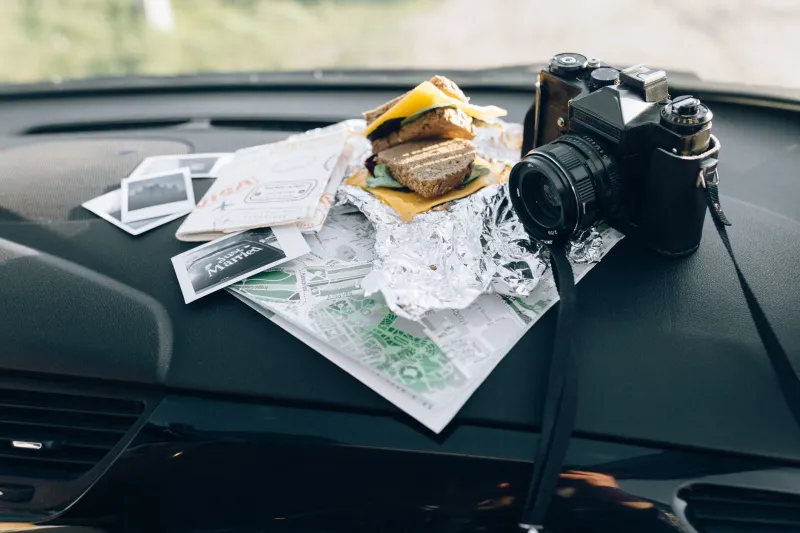
There is a particular sound a paper map makes when it is refolded wrong — a dry, recalcitrant crackle, like the map itself objecting to your carelessness. For a rising number of American travelers, that sound has become something of a signature. They are the ones you'll find at a two-pump gas station outside Marfa or Hannibal, squinting at a creased state map, phone face-down and deliberately inert in the cupholder. They have chosen, with full knowledge of what they're giving up, to be unoptimized.
It would be easy to file this under nostalgia, and plenty of trend pieces have. But nostalgia is the wrong frame. What's happening on the American roadside is less a retreat into the past than an argument about the present — one that artists, writers, and the culturally restless are making with their odometers.
The Route as a Commodity
Consider what the navigation app actually sells. Not directions, exactly — certainty. Every suggested route is a small verdict about what your time is worth and what you should find interesting. The algorithm's map is a map of probabilities: this exit has been rated, that overlook has been photographed forty thousand times. It flattens the country into a shortest-path problem.
The analog traveler declines the verdict. In doing so, they reclaim something the app cannot price: the possibility that the next exit matters for no reason anyone has yet recorded. It is a position with a lineage. Whitman claimed the open road as a room 'wherein to wait a while'; Emerson insisted that travel was useless unless it unsettled the traveler's certainties. The current revival is, if anything, a return to Emerson — the road trip as a machine for producing doubt, which is to say, for producing thought.
Getting Lost on Purpose
Talk to the people doing this and a pattern emerges. They are not anti-technology; they are anti-prediction. A twenty-six-year-old illustrator from Portland described her practice this way: she plots a corridor on paper, forbids herself the interstate, and commits to stopping at any hand-painted sign — ROCK SHOP, PIE, WORLD'S LARGEST WHATEVER — that she cannot research beforehand. 'The second you can look something up,' she told me, 'it stops being a discovery and becomes a confirmation.'
That distinction — discovery versus confirmation — is doing real cultural work. The suggested route gives you the country you already suspected existed. The unplanned detour gives you something closer to the country as it experiences itself: the volunteer fire department's fish fry, the county historical society open three hours a week, the water tower painted by the graduating class of 1979. None of it will trend. All of it is true.
America's First Canvas
It's worth remembering that the road trip was never really about transportation. From Route 66 onward, the American drive has been a creative form — a narrative structure with a beginning, an accumulating middle, and an ambiguous end. Kerouac understood it. The WPA road guides understood it. The great roadside vernacular — the googie diners, the neon motels, the giant fiberglass mascots — was folk architecture built specifically for the drifting eye.
That canvas fell into disuse as the interstate system prioritized throughput over texture. But the materials are still there, and the new pilgrims are finding them. Small towns that spent decades bypassed are seeing a modest, meaningful return of the traveler who stays a night instead of passing through at seventy miles an hour. Diners that survived on locals alone now fill a few stools on weekends with people who ask questions and tip in cash.
A Generation Against the Suggested Route
The demographic surprise is age. Surveys of map and guidebook sales suggest the analog-travel revival is powered disproportionately by travelers under thirty-five — the same cohort that supposedly wants everything frictionless. But friction, it turns out, was the point. Raised on feeds that end only by exhaustion, this generation has developed a sophisticated allergy to experiences that arrive pre-curated. The road trip, done the old way, is the one American art form that cannot be scrolled.
There is a political undertone here as well, though it rarely announces itself. To insist on the unplanned is to insist that your attention belongs to you. The suggested route is, among other things, someone else's monetization of your curiosity. Refusing it is a small act of sovereignty — and, like most such acts, it begins modestly, at a rest stop, with a map that won't fold right.
The Point of the Wrong Turn
None of this will register in GDP figures. The analog road trip is inefficient by design, and its adherents would be suspicious of any metric that praised it. What it produces instead is harder to tabulate: stories with actual stakes, memories organized by surprise rather than itinerary, and a slowly renewed intimacy with a country that, at ground level, remains far stranger and more generous than its thumbnails suggest.
Emerson warned that we travel to see the world and end up seeing ourselves. The algorithm promises to spare us that risk. A paper map, held against the dashboard of a car with no particular destination, makes the same promise it always made: that the road ahead is genuinely unknown, and that this is not a bug.
The last Emersonian isn't driving toward anything. They're driving toward not knowing — and the country, it turns out, still has plenty of that left.