Painted Before the Paint Fades: The Volunteer Cartographers of America's Vanishing Walls
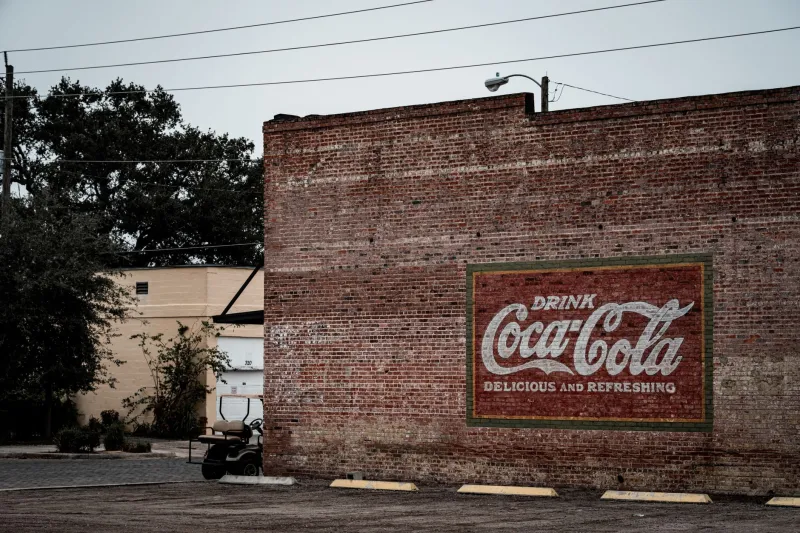
There is a particular kind of silence that settles over a brick wall in a town like Emporia, Kansas, or Honesdale, Pennsylvania, when the afternoon light hits it just right. Look long enough and the wall begins to speak. A woman's profile in a wide-brimmed hat, advertising a hat shop that closed during the Eisenhower administration. The faded serif of a shoe company that no one alive remembers buying from. These are the ghost signs—hand-painted commercial murals applied directly to brick and mortar between roughly 1870 and 1930, and still, improbably, clinging to the sides of American buildings.
They are disappearing at a rate that outpaces any organized effort to record them. And a small, loosely organized network of people is trying to do something about that.
The Wall Is the Archive
Ghost signs were never meant to last. They were, in their day, simply advertisements—cheap, effective, painted by itinerant wall dogs who worked from scaffolds with buckets of lead-based paint and an eye for scale. What preserved them was neglect. When the businesses failed or moved on, the buildings changed hands, and successive owners simply painted over or around the old walls rather than scraping them clean. Layer upon layer of commerce accumulated, and every few decades, weathering or demolition would strip away the newer surfaces and reveal an older one beneath.
What this means is that a ghost sign is not really a single artifact. It is a stratigraphic record. A wall in downtown Paducah might carry a 1912 tobacco advertisement, a 1928 furniture store overlay, and the ghostly outline of a 1950s appliance dealer—all visible at once, depending on how the light falls. Historians of consumer culture have come to treat these walls as primary sources, documenting the rise of national brands, the migration of retail from Main Street to the highway, and the precise moment when local merchants began competing with companies whose names everyone knew.
The vocabulary of these signs is its own museum. Dr. Pierce's Favorite Prescription. Squirrel Brand nuts. Mail Pouch chewing tobacco, whose barn-side campaigns were so ubiquitous that they constitute their own preservation movement. Each brand name is a door into a vanished commercial ecosystem—one where a paint company might sponsor a traveling artist, or where a soft drink fought for wall space against a patent medicine.
The People Chasing the Paint
The documentation effort is led not by institutions but by hobbyists and tradespeople. Sign hunters—many of them organized through online communities that grew out of early 2000s Flickr groups—photograph and geotag surviving examples, often returning to the same wall year after year to track its decay. Their photographs, shared freely, have become the de facto national archive. When a building burns or is demolished, those images are frequently all that remains.
Working sign painters have joined the effort from a different direction. A modest revival of the hand-lettering trade, driven in part by designers seeking analog craft skills, has produced a generation of muralists who can read a ghost sign the way a conservator reads a fresco—identifying the brushwork, the pigment, the tricks of the trade. Some of these painters take restoration commissions, carefully repainting a century-old advertisement using period techniques. Others argue, sometimes heatedly, that repainting destroys the very thing that makes the sign meaningful.
That argument is the heart of the matter.
Preservation or Embalming?
To restore a ghost sign is to make a decision on behalf of a building, a town, and a dead sign painter: that this image, in this condition, is worth arresting in time. Critics of restoration point out that a crisply repainted Mail Pouch advertisement is no longer a ghost at all—it is a reproduction wearing the skin of an artifact. The weathering, the fading, the partial legibility: these are not damage to be repaired but the accumulated evidence of a century of American economic life.
Defenders of restoration counter that fading is not neutral, either. A wall left to dissolve will eventually dissolve entirely, taking its history with it. In towns where the ghost sign is one of the few remaining markers of a once-thriving commercial core, repainting can be an act of civic self-regard—a declaration that the past is worth the cost of a scaffold and a bucket of paint.
There is no consensus, and perhaps there should not be. What seems increasingly clear is that the window for making any decision at all is closing. Lead paint flakes. Brick spalls. Owners, facing redevelopment pressure, seal facades behind vinyl siding or fresh coats of latex, and the stratigraphy is lost in an afternoon.
Reading the Walls While They Remain
For the culturally curious, the ghost sign offers something rare: an artwork you can encounter without admission, created by unnamed laborers, addressed to shoppers who have been dead for generations. Its meaning has shifted entirely from persuasion to elegy, and that shift happened without anyone's permission.
Whether the right response is a camera, a conservation grant, or a fresh coat of deliberate inaction, the urgency is real. The walls are speaking more faintly each year. The least we can do, before the last pigment lifts off the brick, is stand in the right light and listen.