Friction as Freedom: Why Gen Z Creators Are Reaching Past the Screen
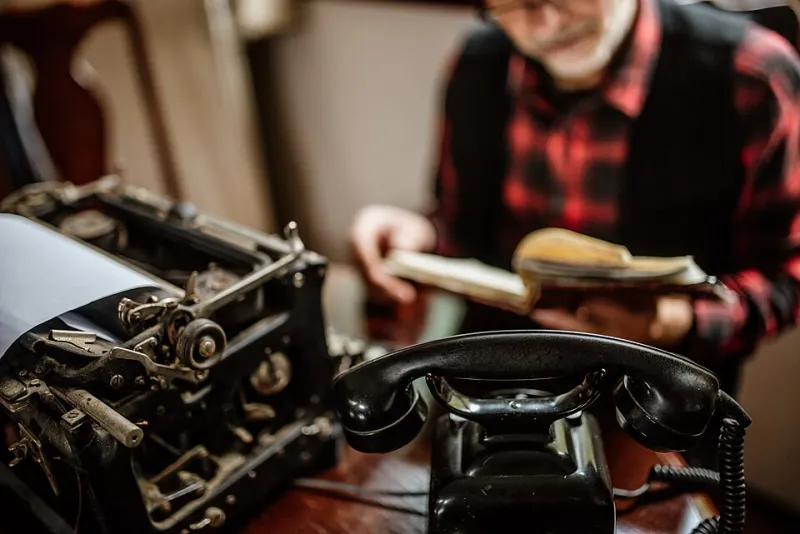
Photo: Shixart1985, CC BY 2.0, via Wikimedia Commons
There is a particular sound a typewriter key makes when it strikes the platen — a small, definitive percussion, equal parts mechanical and intimate. It is not the sound of efficiency. It is not the sound of a cursor blinking in an empty document at two in the morning, awaiting something that feels perpetually unready. It is, for a surprising number of young American creators, the sound of relief.
Across studios, apartments, and rented practice spaces from Portland to Philadelphia, a counterintuitive shift is quietly reshaping how a generation of artists works. Typewriters are being reclaimed from estate sales. Record players occupy the center of living rooms that have never known a CD player. Handwritten letters — sealed, stamped, sent — are arriving in mailboxes with a frequency that the postal service hadn't anticipated from people under thirty. None of this is accidental. None of it is simply aesthetic. It is, by many accounts, a form of survival.
The Algorithm Problem
To understand why young creators are reaching backward, it helps to understand what they are reaching away from. The digital creative ecosystem — social platforms, streaming services, cloud-based production tools — offers extraordinary access and, in the same gesture, extraordinary surveillance. Every creative act performed online is measured, ranked, and fed back to its maker as data. An album released on a streaming platform arrives already instrumented with listener analytics. A poem posted to social media becomes, within hours, a performance to be optimized.
For many Gen Z artists, who came of age entirely within this feedback architecture, the psychological toll has been considerable. The writer Margot Ellison, twenty-four, who maintains a small but devoted readership through a printed zine she mails from her apartment in Columbus, Ohio, describes the experience of writing for digital platforms as "composing with a crowd already in the room." The crowd, she notes, is not imagined. The metrics are real. The pressure to produce content that performs — rather than content that simply exists — has driven many of her peers toward what she calls "the dignity of the unseen."
The handwritten letter, in this context, is not a quaint affectation. It is a radical act of privacy.
Limitation as Method
There is a long and serious tradition in art of embracing constraint as a generative force. The Oulipo writers famously composed entire novels under self-imposed linguistic restrictions. Filmmakers working in early cinema found beauty precisely because technology demanded it. What distinguishes the current analog revival is that its constraints are not invented — they are inherited, rediscovered, and chosen.
A typewriter cannot be edited in the same fluid, reversible way that a word processor can. This is not a bug. For many writers, it is the entire point. The commitment demanded by each keystroke — the knowledge that correction is laborious, that deletion leaves a visible mark — changes the relationship between thought and language in ways that digital writing, for all its convenience, cannot replicate. You choose your words differently when changing them costs something.
Musicians working with vinyl face a structurally similar condition. The format is not infinitely malleable. The physical record holds a fixed amount of music per side, demands intentional sequencing, and resists the shuffle logic that streaming has made universal. Artists who record to tape and press to vinyl are making decisions about their work that digital production actively discourages: decisions about duration, about silence, about the coherent shape of a listening experience.
Jordan Carew, a twenty-seven-year-old composer and multi-instrumentalist based in New Orleans, released his most recent album exclusively on vinyl and cassette, with no streaming equivalent. "I wanted people to have to decide to listen," he says. "Streaming makes listening passive. I wanted the decision to cost something — even if it's just the ten seconds it takes to flip a record."
Burnout and the Body
It would be a mistake to read the analog revival purely as an intellectual or aesthetic movement. Its emotional substrate is burnout — a condition so widespread among young creatives that it has become, in certain circles, the default assumption rather than the exception. The particular burnout of the digital creative is distinct from simple exhaustion. It involves a kind of alienation from the work itself, a sense that the product of one's creativity has been absorbed into a system that processes it as content, indistinguishable from everything else.
Analog tools reintroduce the body into creative practice in ways that digital tools systematically remove. A handwritten letter requires physical presence — the particular pressure of a pen, the idiosyncrasy of one's own hand, the irreversibility of ink. A typewriter requires physical force. Developing film in a darkroom requires patience, chemical knowledge, and the willingness to work in darkness. These are not merely romantic inconveniences. They are forms of engagement that return the maker to the material reality of their own labor.
For many young artists, this return is experienced as a form of healing. The creative act becomes, again, something that takes place in the world rather than inside a device.
Resistance Without Manifesto
What is perhaps most striking about this movement is its deliberate quietness. There is no unified manifesto, no branded aesthetic, no hashtag that adequately captures it — and many of its participants seem to prefer it that way. The analog revival, insofar as it constitutes a cultural stance, is most coherent as a refusal: of optimization, of visibility, of the relentless demand to produce work that is legible to an algorithm.
This is not technophobia. Most of the artists engaged in this shift use digital tools for other aspects of their lives and work. The choice to write on a typewriter or press music to vinyl is not a rejection of technology in general — it is a rejection of specific technologies that have come to feel, for many young creators, less like tools and more like employers.
That distinction matters. Tools serve the maker. Employers extract from them. The analog revival, at its most articulate, is simply an insistence on remaining the former rather than becoming the latter.
In that insistence — modest, unhurried, conducted largely out of public view — there is something that the digital creative ecosystem is structurally incapable of producing: the quiet authority of a thing made slowly, for no audience in particular, by someone who was not being watched.