The Nightstand Exchange: On the Paperback Libraries of American Motels
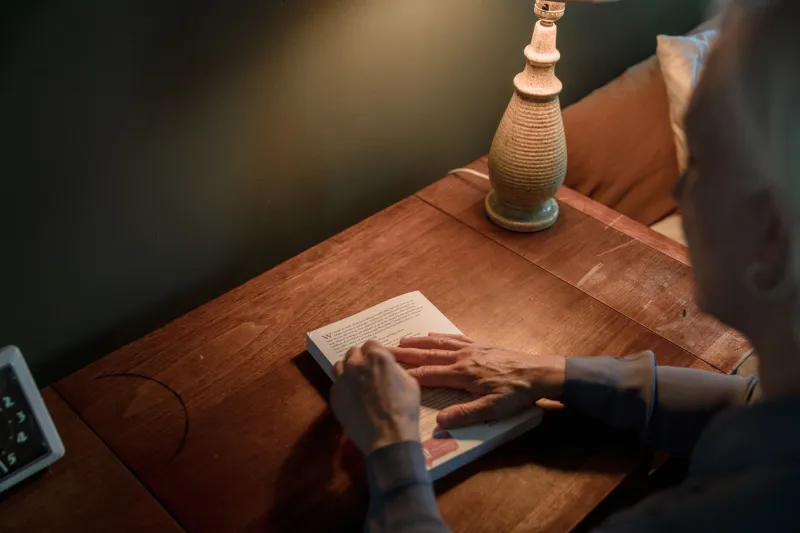
The first book I found was a waterlogged paperback of The Bridges of Madison County in a motel in Needles, California. It was in the nightstand drawer, beneath a Gideons Bible and a laminated card explaining the wifi password. The cover had swollen and dried into a shape that was no longer quite rectangular. On the title page, someone had written: “For whoever needs it. — R.”
That was eleven years ago. I have been looking in nightstand drawers ever since. What I have found is not a system. It is a loose, unorganized lending network that no one designed and no one administers, a shadow library that moves through motels, motor lodges, and budget hotels like water through limestone.
The Nightstand Drawer
The nightstand drawer is the most intimate piece of furniture in a motel room. It is where the Bible lives, and the phone book, and the card that tells you how to dial the front desk. It is also, in hundreds of American motels, where a previous guest has left a book. The book is rarely a bestseller. It is often a mass-market paperback with a cracked spine: a thriller, a romance, a memoir someone finished on vacation and did not want to carry home.
The drawer is a threshold. The book in it is not exactly a gift, because the giver is gone. It is not exactly a loan, because there is no return date. It is an offering, made without expectation, to a stranger who will never be thanked.
A Loose Network
I have traced a few of these books. A copy of The Joy Luck Club that I found in a motel in Flagstaff, Arizona, had a sticker from a used bookstore in Iowa City on the back. Inside, a name in blue ink: “Margaret, 1994.” I called the bookstore. The owner, a woman named Jan, told me that Margaret had been a regular customer who moved away. She did not know how the book had traveled 1,400 miles. She was delighted. “That book is having a better life than I am,” she said.
The network has no rules, but it has customs. Books are left, not sold. They are left in drawers, on lobby shelves, in laundry rooms, on the mantel above the fake fireplace. They are left with notes, or without. They are left by people who finished them and did not want to throw them away, and by people who bought them at an airport and realized they would not read them, and by people who found them in another motel and decided to pass them on.
The Desk Clerk’s Discernment
The desk clerk is the network’s unofficial curator. At a motel in Tucumcari, New Mexico, the clerk, a woman named Darlene, keeps a shelf behind the front desk. She decides which books go out to the lobby and which stay in the back. “I don’t put out the ones that look like they’ve been in a flood,” she says. “And I don’t put out the ones with too much sex on the cover. Families stay here.”
Darlene’s discernment is not censorship. It is a form of care. She knows her guests. She knows that a truck driver will take a Louis L’Amour and a family will take a John Grisham. She knows that the books she puts out will probably not come back, and she is fine with that. “It’s not a library,” she says. “It’s a motel. People are passing through.”
Following a Copy
I followed one copy for three years. It was a paperback of Cannery Row that I found in a motel in Monterey, California. Inside the front cover, a note: “Left by J., who loved this place.” I read it, then left it in a motel in Big Sur. A year later, a friend found a copy in a motel in Santa Cruz with the same note. It may have been the same copy. It may have been a different copy with a similar note. I prefer to think it was the same.
Following a book is not like following a person. You cannot interview it. You can only infer. The book’s condition tells you something: the cracked spine, the coffee ring, the sand between pages 112 and 113. The inscription tells you something else. The book becomes a record of its own travels, a passport with no stamps.
The Ethics of Leaving
There is an ethics to this, though no one enforces it. Do not take a book you will not read. Do not take a book you will not pass on. Do not take the Bible. Do not take the book with the note that says “For whoever needs it” unless you need it. And if you do need it, take it. That is what it is for.
The ethics are loose because the network is loose. There is no librarian, no due date, no fine. There is only the next guest, and the next drawer.
What Stays
I still look in nightstand drawers. I have found fewer books in recent years. Motels are changing: the drawers are smaller, the Bibles are gone, the wifi cards are laminated and permanent. But the books are still there, in the lobby, on the shelf by the ice machine, in the laundry room where someone left a paperback of The Firm next to a box of dryer sheets. The network is not disappearing. It is moving.
The book I remember most is not one I kept. It was a paperback of Their Eyes Were Watching God that I found in a motel in Mobile, Alabama. On the inside cover, someone had written: “Read this in one night. Cried. Left it for you.” I read it in one night. I cried. I left it for the next person. I do not know who they were. I hope they needed it.