Lead, Ink, and Devotion: A Day in the Shop Where Type Is Still Set by Hand
The pot has been melting since six. By seven, the smell of hot lead and linotype oil has filled every corner of the shop, and Ruth Calloway, seventy-one, is standing at a composing stone that has not been idle since 1987.
The job before her is modest: a wedding broadside, two hundred copies, commissioned by a couple from Columbus who found her through a friend of a friend. In the digital age, the same piece could be designed, proofed, and printed in an afternoon. Calloway will spend four days on it. She considers this a bargain.
"People think I'm being stubborn," she says, sorting brass matrices with a practiced flick of the wrist. "I'm not stubborn. I'm just not finished yet."
A Technology Declared Dead — Twice
Hot metal typesetting was supposed to die in the 1960s, when phototypesetting promised cheaper, faster, cleaner production. It was supposed to die again in the 1980s, when desktop publishing moved composition to the screen. Obituaries for the Linotype were written so often that the trade press stopped publishing them.
And yet. Across the United States, a small but devoted cadre of printers — many of them trained in newspaper composing rooms before the industry collapsed, many more self-taught through museums and workshops — continues to set type the old way. The Museum of Printing in North Andover, Massachusetts, runs regular demonstrations on working Linotypes. The Hamilton Wood Type & Printing Museum in Two Rivers, Wisconsin, preserves what may be the largest collection of wood type on earth. And in garages and barns from Vermont to Oregon, working shops like Calloway's take on jobs that no algorithm can replicate.
The American Printing History Association estimates that only a few hundred active hot metal practitioners remain nationwide. Their numbers are small. Their influence, among designers and collectors, is not.
The Anatomy of a Single Job
A broadside begins, as all hot metal jobs do, with words. Calloway reads the couple's chosen text aloud twice — a line from Mary Oliver, their names, the date — listening for rhythm before she touches a single piece of metal.
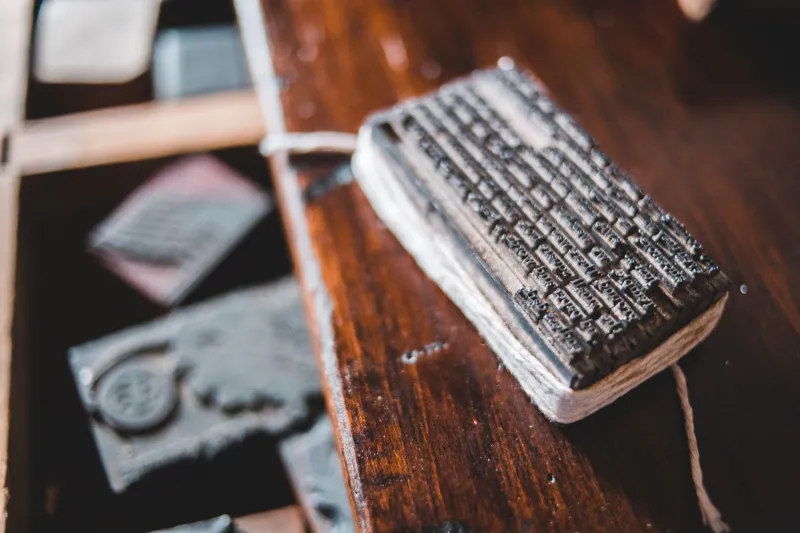
Then comes composition. For the headline, she hand-sets individual lead sorts from her California job case, each letter placed backwards and upside down in the composing stick, the way every apprentice has done since Gutenberg. For the body text, she turns to her Ludlow Typograph, a machine that casts entire lines of type from matrices she assembles by hand.
The matrices themselves are the heart of the craft — brass molds, some dating to the 1930s, engraved with letterforms in faces like Cheltenham and Engravers Old English. Calloway's collection, inherited from a shuttered job shop in Dayton, includes several fonts that no longer exist in any digital foundry. When she sets a line, she is quite literally casting from history.
"Every piece of metal in this shop was made by somebody who's probably dead," she says. "I'm the youngest link in a very long chain."
The Press, and the Point of It All
Printing happens on a Chandler & Price platen press built in 1911 — a machine of flywheels and foot treadles that weighs more than a modern car. Ink mixed by hand, paper dampened for better impression, each sheet fed one at a time. Two hundred impressions, each requiring the same attention as the first.
The result bears the hallmarks that have made letterpress a luxury good: a debossed impression you can feel with a fingertip, ink with body and texture, slight variations that mark each copy as individually made. In an era when perfection is free, imperfection has become the expensive thing.
Design scholars have a term for this — the "haptic premium" — but Calloway has a simpler explanation. "A screen shows you the words," she says. "A letterpress print gives them to you. There's a difference between seeing and holding."
The Succession Problem
The fragility of the craft is not lost on its practitioners. Lead is heavy and scarce; equipment is irreplaceable; and the apprenticeship pipeline, once supplied by union composing rooms, has narrowed to workshops, museum programs, and a handful of book arts programs at institutions like the University of Iowa and Columbia College Chicago.
Still, there are signs of life. Young designers increasingly seek out letterpress for wedding invitations, art editions, and packaging, willing to pay craft prices for craft objects. Nonprofit teaching shops — from Asheville's Book Works to Seattle's School of Visual Concepts — report waiting lists for introductory classes.
Calloway has taken on two apprentices, both in their thirties, both of whom found her the way most people find anything now: online. She finds the irony acceptable.
"The internet brought them to my door," she says, pulling the final proof of the broadside and holding it to the window light. "What they do at the door is up to them."
The couple's names stand in crisp relief, each letter pressed into cotton paper with the weight of a century of practice. Somewhere in Columbus, a wedding will include a piece of metal, ink, and muscle — proof that the obituary writers were premature, and that some technologies refuse to die so long as someone is willing to get up early and melt the lead.