The Figure at the Door: How the Stranger Archetype Has Always Held a Mirror to American Fear
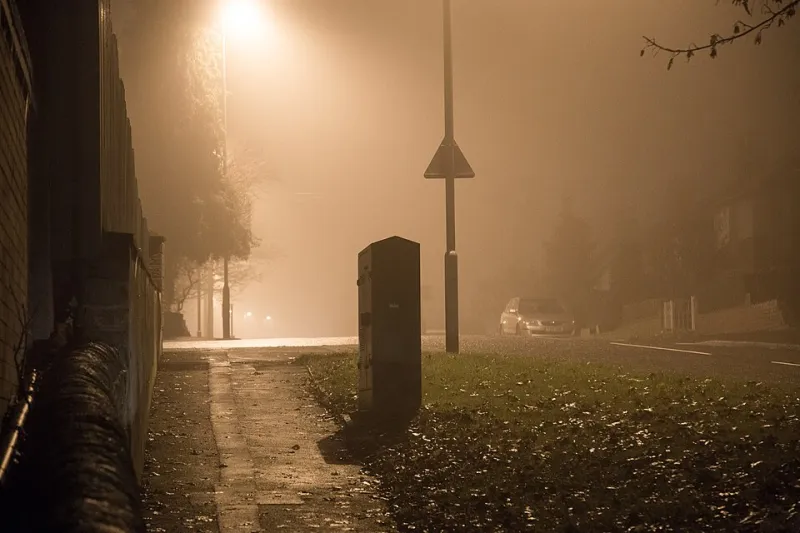
Photo: Rob Faulkner from Leeds, United Kingdom, CC BY 2.0, via Wikimedia Commons
Consider the moment. A knock at the door, or perhaps no knock at all — just a presence, suddenly there, at the edge of the known world. The stranger does not announce itself with obvious malice. It simply arrives, wearing an unfamiliar face, speaking in cadences that are almost but not quite right. In American storytelling, across centuries and mediums, this figure has served as the primary vessel for the fears a culture cannot articulate through more rational means.
The stranger, as archetype, is not a monster in the conventional sense. Its power lies precisely in its ambiguity. It may be dangerous. It may be transformative. It may, in the most unsettling iterations, be entirely benign — which somehow makes it worse. What it invariably represents is the boundary between the familiar and the unknown, and the terror of what happens when that boundary is crossed.
Roots in the American Soil
Long before the stranger appeared on screen or page, it haunted the oral traditions of the continent. Indigenous storytelling traditions across North America include figures of ambiguous arrival — beings who approach settlements or travelers in the guise of the ordinary and reveal themselves, gradually or catastrophically, as something else entirely. These narratives served practical and spiritual functions simultaneously, encoding warnings about the unpredictable natural world in the grammar of the uncanny.
European settler folklore imported its own variations. The Appalachian tradition is particularly rich with strangers: the well-dressed traveler who offers a bargain at a crossroads, the pale guest who arrives at a farmhouse during a storm and is gone by morning, leaving something subtly wrong in his wake. These stories, many of which were carried across the Atlantic from British and German oral traditions, were reshaped by the particular anxieties of the American frontier — a landscape where genuine strangers were common, and where the line between hospitality and vulnerability was dangerously thin.
What is notable, in retrospect, is how often these folkloric strangers embodied the cultural anxieties of their moment. The dangerous traveler of nineteenth-century rural folklore frequently carried the coded features of whoever the dominant community feared most: the itinerant laborer, the person of unfamiliar ethnicity, the woman traveling without a male escort. The stranger, in other words, has always been a projection as much as an invention.
Rod Serling's Uncomfortable Guests
No American cultural form weaponized the stranger archetype more precisely or more politically than The Twilight Zone. Rod Serling's anthology series, which premiered in 1959 and ran through 1964, returned obsessively to the figure of the outsider whose presence exposes the moral rot concealed beneath surfaces of normalcy.
In episodes like "The Monsters Are Due on Maple Street," the stranger is never actually seen — the true horror is the community's readiness to designate one of its own members as the alien threat. In "Will the Real Martian Please Stand Up," the stranger is hidden in plain sight, indistinguishable from the ordinary until it is far too late. Serling understood that the stranger's function was not to frighten audiences with the genuinely foreign but to turn that fear back on themselves — to ask who, exactly, was doing the designating, and why.
This political dimension is essential to understanding the archetype's persistence. The stranger does not merely represent the unknown. It represents whatever a given culture has decided to make unknown — whatever it has chosen not to see, not to name, not to integrate. The stranger is the return of the repressed, wearing a human face.
Contemporary Terrain: From Hawkins to the Wilderness
Decades after Serling, the stranger archetype continues to evolve in American prestige television, adapting itself to new anxieties with remarkable agility. Stranger Things, for all its affectionate nostalgia, is structured around the arrival of figures who do not belong: the girl with the shaved head who appears from nowhere, the creatures that seep through from an adjacent reality. The series is, at its core, a meditation on what small-town America excludes and what the excluded eventually becomes.
More recently, Yellowjackets — Showtime's acclaimed drama about a girls' soccer team stranded in the Canadian wilderness after a plane crash — has offered one of the most sophisticated deployments of the stranger archetype in recent memory. The wilderness itself functions as the stranger, a space beyond social law where the girls' identities dissolve and reform around impulses their ordinary lives had suppressed. But the series also literalizes the archetype through its adult timeline, in which the survivors, now middle-aged women, are stalked by a figure who seems to know what happened in the woods. The stranger here is memory — the past arriving unannounced, demanding to be acknowledged.
What connects these contemporary iterations to their folkloric predecessors is a shared preoccupation with the threshold. The stranger always arrives at a boundary: between the known and the unknown, between the community and its outside, between the self and whatever the self has refused to become.
Science Fiction and the Stranger as Existential Probe
In science fiction, the stranger archetype expands into genuinely cosmic register. The alien visitor — from the ambiguous extraterrestrials of Denis Villeneuve's Arrival to the body-horror intimacy of Octavia Butler's Bloodchild — asks not merely "who are you?" but "what are you?" and, more disturbingly, "what will you become in my presence?"
Butler's work is particularly instructive here, because it refuses the comfortable binary of the stranger as threat. Her aliens are neither benevolent nor malevolent in any simple sense; they are genuinely other, with needs and logics that cannot be mapped onto human frameworks. The terror Butler generates is not the terror of the monster but the terror of genuine encounter — the vertigo of confronting something that cannot be assimilated, that will require you to change in order to understand it.
This is, arguably, the stranger archetype at its most philosophically honest. The figure at the door is frightening not because it is evil but because it is genuinely new, and genuine newness requires genuine transformation. American culture, with its deep investment in the stability of established hierarchies, has always found that prospect profoundly unsettling.
What We Fear When We Fear the Stranger
To trace the stranger across American folklore, literature, and screen is to trace the contours of American anxiety itself: fear of the outsider, fear of contamination, fear of change, and — perhaps most fundamentally — fear of the self that might emerge through contact with the genuinely different.
The archetype endures because it is honest about something the culture often is not. Every generation produces its own strangers, its own figures of ambiguous arrival, because every generation carries its own unacknowledged fears. The stories we tell about those figures are not merely entertainment. They are, in the oldest sense of the word, a form of reckoning.
The knock at the door continues. The question, as it has always been, is whether we will open it.